Popular Posts

Thursday, April 5, 2012

Cedar Plank Grilled Salmon

Ingredients:
1 lb fresh salmon
2 tbs brown sugar
1 tbs pure maple syrup
Yellow mustard
Olive oil
Four peppercorn blend to taste
Sea salt to taste


Directions:
Start out by soaking an untreated cedar plank in water for about 20 minutes. This will prevent it from catching on fire while on the grill. Preheat grill to 300 degrees. Rinse salmon in cold water before rubbing the piece of salmon with mustard, salt, pepper, brown sugar, and pure maple syrup.  Take the cedar plank out of water then rub it with olive oil to prevent sticking. Place the salmon skin side down on the cedar plank. Grill the salmon for approximately 40 minutes at 300 degrees or until it reaches an internal temperature of 135 f. Note: Keep a spray bottle of water nearby in case the cedar plank would start to burn. Remove cedar plank from the grill and serve. This truly is a delicious yet simple recipe for salmon. My favorite!

Enjoy!


Beverage Recommendation: Granite City's Brother Benedict's Bock

Sunday, March 18, 2012

Kamloops Fishing on Lake Superior

This time of year is always bitter sweet for me. It's that time of year when I realize that my winter fishing season is over. I'm going to let you in on a secret that will help you with your winter fishing withdrawals. It won't cost more than a few bucks in gas and a tub of wax worms. It's the incredible fishery that exists on the shorelines of Minnesota's Lake Superior. Early March is the time that Lake Superior Kamloops Rainbows begin to stage off river mouths in anticipation for their spring spawning migration. It's a time of year when these large Great Lakes fish are within casting distance from shore and can make for a memorable outing. The best part is a big boat or charter is not needed and this can all be done with equipment you currently own.

  Many areas from Duluth to the Canadian border can produce fish but I prefer areas that are in close proximity to warm water discharges or river mouths. These areas with warmer water are going to offer food and attract fish. Steelhead and Kamloops always return to spawn in their birth stream and spend the months of February and March seeking out these streams. This makes them susceptible to a wide variety of offerings from a savoy angler.

As for equipment I like to use long light action rods. The long rod allows for greater casting distance. It also allows you to fight large fish on light line by fighting them on the rod rather than the line. Simply keeping your rod tip up will absorb alot of the shock from the powerful runs these fish make. Just don't make the mistake of pointing your rod at the fish or all shock is taken by the line. A reel with a good ball bearing drag system will also help bring these fish to hand. For line I like an abrasion resistant 6 pd test. This keeps my line from getting nicked up on the many boulders that line Lake Superiors shoreline, but is not visible in the clear water.
   The two main techniques used are bobber fishing and plunking. A variety of weighted bobbers are available that allow you to get enough distance to get out past the shoreline rocks. A leader of 18-30" is then added. On the business end a special jig tied with rubber legs and a marabou tail known locally as a "looper bug" is the bait of choice. I've also used small bead head flies, night crawlers, wax worms and fresh spawn tied into mesh bags.

The second method is much like a walleye rig. It starts by adding a sliding sinker followed by a bead and then a high quality barrel swivel is tied onto the line. A leader of 16-25" of fluorocarbon is then tied on, followed by a #6 hook. This rig is tipped with a night crawler filled full of air from a worm blower or a mesh sack filled with spawn and a marshmallow. This rig is cast out and the slack line reeled up. The bait floats up off bottom and the line slides freely through the sinker on bottom. It is placed into a rod holder and watched closely for bites. Bites can range from violent strikes ripping line to something as simple as the line going slack. I have made a few sand spike rod holders by taping a chuck of PVC pipe onto a piece of re-rod. This can be driven into the sand and holds up to even the most violent strikes from passing Kamloops Rainbows.

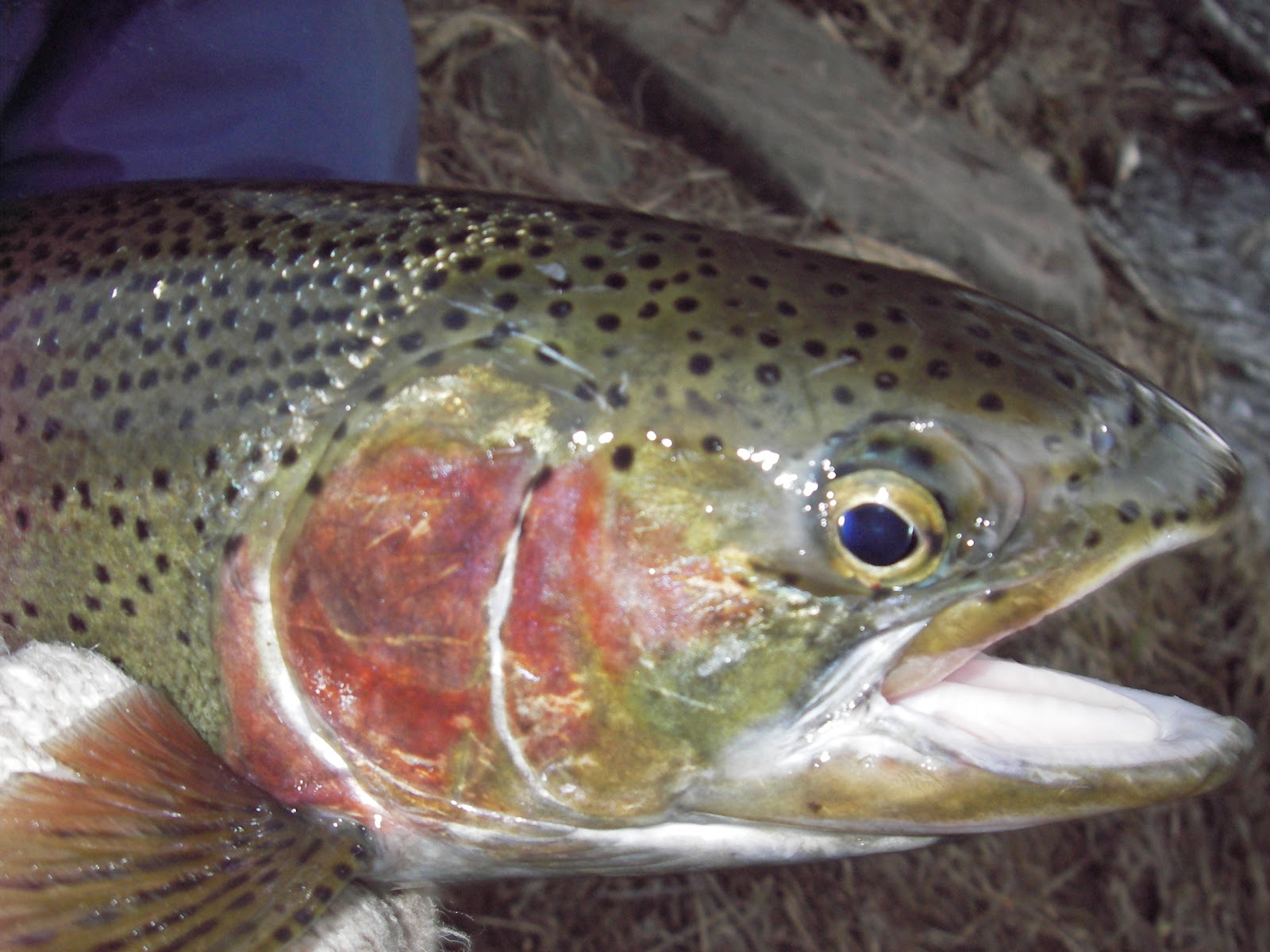
The Kamloops Rainbows of Lake Superior are stocked by the Minnesota Department of Natural Resources. These fish can be identified by a clipped adipose fin. Any fish that has an adipose fin is a wild steelhead and must be immediately released. If you do hook into a wild fish be sure to not over handle the fish. These fish should only be handled briefly for a photograph. Keep them in the water at all times. Wet hands before handling to not rub the protective slime coat off the fish. If this slime coat is damaged the fish is susceptible to infection. The steelhead of Lake Superior were in danger during the 1990's. The fish are starting to rebound due to responsible angler handling and a strict catch and release policy adopted by the Minnesota DNR. Should you catch one please do your part to protect this great fish.

Fill the void left over from the ice fishing season with a trip to Lake Superior for Kamloops Rainbow Trout. These fish make drag burning runs often leaping a few feet out of the water once hooked. You will not be disappointed. Who knows you may become "hooked" yourself!


Monday, March 12, 2012

Russian River Coho Fly

I am going to show you how to tie a Russian River Coho Fly. I've used this pattern with great success for Great Lakes King Salmon and of course on Kenai River Sockeyes in Alaska. If you plan to use this fly on the Russian River or at the Kenai and Russian River confluence area keep in mind that you cannot have a hook gap of over 3/8". The key for me is to tie them SPARSE. If you use a lot of buck tail the fly will be buoyant and not sink until the middle of your drift. Salmon are on the bottom and you want to get down to them as quickly as possible. Try the Russian River Coho Fly for your dream Alaskan vacation or simply as a pike or Chinook Salmon pattern on your local waters, you will not be disappointed.


Supplies
Hooks-
 Gamakatsu Russian River #2 streamer hooks or Mustad 36717 are popular choices.
Thread-
I like black in a 2/0 size.
Buck tail-
 As for buck tail, you'll need an orange and a white. People use many different color combinations but split orange and white most closely resembles a cloud of plankton, the favorite food source of the Sockeye Salmon. A red and white fly is thought to imitate a tiny fish called a sandlance and is the second most popular choice.
Tools-
 Hair stacker, scissors and water based head cement.
Optional Materials-
 Chenille or tinsel for body material and crystal flash for added sparkle.


Instructions
 1. Wrap your hook shank about half way down with thread. Tie in body material if you choose.
 2. Wrap thread back to eye of hook then add a small drop of head cement.
 3. Cut white buck tail and put into stacker. Pinch between thumb and index finger and hold onto one side of the hook.

 4. Wrap around shank tightly with thread. Repeat for other side with orange buck tail. I like to tie both colors in seperately to keep colors seperate.

 5. Finish by making 4-5 wraps with thread around both sections of buck tail. Be careful not to crowd the hook.

6.Whip finish and add a few drops of head cement.

Saturday, March 3, 2012

Salmon Patties

Ingredients:
-1 1/2 lbs of Fresh Alaskan Salmon
-2 Eggs
-1/2 cup of chopped onions
-1 roll of Ritz crackers
-2 tbs flour
-1cup of milk
-2 tbs butter
-four peppercorn seasoning


Directions:
Salmon Patties- Use grinder to grind fresh salmon. Mix fresh salmon in mixing bowl with 2 eggs, 1/2 cup chopped onion, and roll of crumbled Ritz crackers. Make mixture into 4 patties and place on greased pan. Season patties with four peppercorn seasoning. Bake at 350 for 1/2 hour.


Sauce- Melt butter in small saucepan. Stir in flour and four peppercorn seasoning. Add milk and cook over medium heat until bubbly. Stirring often. Cook and stir 1 to 2 minutes more until sauce thickens.


Smother patties with sauce and enjoy!


Recommended Beverage: Samuel Adams Mighty Oak Ale


Thursday, February 16, 2012

Valentines Day Perch


"Get a bait down quick", Kim instructs as she lifts the camera slowly from the water below. Finding a bio-mass of perch is one thing but keeping them in the area awhile can be a challenge to say the least. It takes fast moving and teamwork. After all were talking about the most nomadic species of them all, the jumbo perch. This was the start of Valentines Day and my wife and I wouldn't have it any other way.

We left home at about 5am, coffee in hand in search of jumbo perch gold. Trailer lights in good working condition I had a good feeling about the day. While other couples spend the day shopping or dinning we would drive up and down break lines probing the depths with the underwater camera. Searching for our next pod of fish. The part we enjoy most about fishing perch (aside from the golden delicious fillets) is the fact these fish are willing afternoon bitters and provide some of the best action of the season.

The strategy was simple drive down the break-lines in 12-14 fow and drill, check with camera and repeat. I like the camera for searching these mid depth flats over the flasher. The narrow cone angle at these relatively shallow depths doesn't show fish. When you stick the camera down it's all black stripes like peering into a jail. Once you've found the bio-mass of fish grab your flasher and get a bait down quick to keep that competitive nature going. These fish will race each other up the water column to your bait. Aggressive jigging will pay off. It's nature versus nurture, and i don't have the time to nurture them.  As soon as you start to get "lookers" instead of "bitters" it's time to move. You've lost the amount of fish necessary to compete. The few fish left are not worth your time. Get into search mode again and find the bio-mass where fish compete and the action is fast.

Bait selection is simple, anything that gets down fast. I am a spoon and minnow head or eurolarve proponent. Kim is much more adept at finesse fishing with soft plastics and hair jigs.

Community spots are for the crappie crowd. When chasing jumbos the spots burn out quick. I recommend leaving the wheelhouse at home and replacing your boots for running shoes. Don't let the winter doldrums get you down. Go out prospect for jumbo, make that sumo perch gold! Once you've found them get ready, a 100 fish day may be in your future;)

Saturday, February 11, 2012

Halibut Taco's

Ingredients: 
16 ounces of halibut
1 package of taco seasoning
Lime juice
2 avocados pitted and scooped
1 cup of plain yogurt
1/4 teaspoon cayenne pepper
dash of ground cumin
2 scallions, chopped
Romaine lettuce
2 tomatoes, chopped
Flour tortillas
Olive oil


Directions: 
In a blender, mix avocados, cayenne pepper, ground cumin and yogurt. Remove from blender once smooth then add chopped tomatoes and scallions. Set guacamole aside.

Cut uncooked halibut into bite size pieces.  Mix halibut with taco seasoning. Place halibut in hot pan on the stove with small amount of olive oil to prevent sticking. Cook halibut thoroughly until it easily flakes apart. Squeeze small amount of lime juice over the cooked halibut.

Now just chop your lettuce, heat your tortillas and you're ready to prepare your Halibut Taco's.

Enjoy!

Beverage Recommendation: Odell's Cutthroat Porter

Wednesday, February 8, 2012

The allure of ice fishing

Beep, beep, beep my alarm clock sounded. It was 5:30 am and time to get moving if I was going to make it to the lake before prime time. Prime time is that magical time when the plankton rises on your local lake. It starts the food chain and kicks the bluegills metabolism into high gear. If your going to fish the harsh Minnesota winters, it's a time you get to know well.

Armed with a lake map and a steaming hot cup of coffee, I bundle up and make my way out to the truck. Eurolarve check, flasher check, should be set to go with all the supplies needed for a day on the water. This is a new lake that I've never been to but according to my research big bluegills exist here. I spent the better part of the night before highlighting mid depth flats where I could begin my search.

Upon arrival I notice that I'm the only truck in the parking lot, success! I climb up onto the trailer and give the Polaris a pull. The smell of snowmobile fills the air. I made it in perfect time to have my holes drilled in total darkness. This is mandatory when chasing elusive bull gills on shallow flats. I strap my auger to the front and make my way out into the darkness. Butterflies fill my stomach as I head out onto the lake. Will I find the fish I'm after? Is the ice in good condition? These are the questions an ice angler asks himself at 6 am after 20oz of coffee.

The gps takes me right to the spot. One of those wide areas on your contour map, a flat in 12 feet. This flat is also adjacent to a small creek running into the lake. I start the auger, and move up and down the breaks making this section of the lake look like swiss cheese. Now I just need the bluegills to cooperate.

Today's mission wasn't about fillets for the table, but rather about finding big fish or bulls as they call them in the business. This lake had experimental regulations by the Minnesota Department of Natural Resources, and carried a 5 bluegill limit. Here I wouldn't even kill 5 tho, because in these hallowed waters 10" fish exist and protecting the resource is of the utmost importance.

It had to be about the 30th hole I fished before I finally hit a pod of bluegills. I reached into my pocket with frozen fingers for some fresh larve. The flasher was lit up with a big group of fish suspended high in the water column. I slowly begin my decent being careful not to spook my fickle prey. A big red line rose on the flasher ascending to my jig above. I keep a little action on my rod tip to keep the fish's interest, working him up at the same time. Finally my rod skips a beat and I sweep high into the air. The rod doubles and I feel the big fish cut and dig into the water below me.


I managed 3 fish all over 8" before the pod moved and I had to return to the snowmobile for the auger. Time to drill again! On goes the chase for this hard water angler. Drilling and fishing, and drilling and fishing. Because the next hole may hold that 10" I've been dreaming about, and smiling I'll let him swim away too.


Tags: "bluegills" "Minnesota" "ice fishing" "big sunnies" "bull gills" "winter panfish" " panfish report" "finding big panfish"