Popular Posts

Friday, April 20, 2012

Rules Regarding Spawn on Lake Superior

I've spent my spring Kamloops season buying spawn bags from gas stations on the North Shore of Lake Superior at astronomical prices. I recently e-mailed the commissioner of the Minnesota Department of Natural Resources for clarification regarding the use of spawn on the Minnesota side of Lake Superior. He forwarded my e-mail to Matthew Miller from the Lake Superior Marine Unit. I asked all the tough questions and Matt answered them all. Thanks for the info Matt!

  1)      Is it the law that you buy commercially disinfected spawn due to VHS?  Due to the spread of different diseases across the country, and to attempt to prevent their spread in MN, the DNR has adopted rules that require that bait comes from certified disease-free locations or is treated by a licensed processor under DNR permit.  These types of bait then have to be labeled as such to be sold to anglers.  Page 12 of the 2012 Fishing Synopsis contains more information.  You as the angler just need to keep the label from when you purchased the bait.
2)      Is it ok to use spawn from a Kamloops Rainbow caught on Lake Superior for bait on Lake Superior?  No.  Current law prohibits the use of game fish, or any part of a game fish, for bait.  Another statute, specific to Lake Superior, specifically prohibits the taking of fish or parts of a fish for bait from the waters of Lake Superior or the St Louis River, regardless of where they are to be used.  Smelt and cisco have recently been exempted from this regulation.  There are proposals to modify these laws in relation to the use and collection of spawn, but this is where the regulations are at this time.
3)      What about buying it online from sources that claim to be disinfected?  Imported bait is fine, including from online sources, but it also has to come from a certified disease-free source or be treated by a permitted bait processor under DNR permit and labeled as such. 
4)      Can a person disinfect their own for personal use?  No, bait can only be disinfected by the holder of a DNR bait preservation permit.
5)      What does a person need to have on their person to prove their spawn is legal and disinfected?  Just retain the label containing treatment and certification information with you while in the field.  For more information on what information is required on the label, please refer to the statute language in 97C.342, sub 7 on the Revisor’s webpage (www.revisor.leg.state.mn.us). 
Please feel free to contact me at my home office (xxx)xxx-xxxx if you have any more questions or wish clarification on any of these issues.  The recent advance of invasive species and aquatic diseases has led to quite a few changes for all anglers and boaters, but hopefully I was able to help you here.
 Matt
 Matthew S. Miller
Minnesota Conservation Officer
Lake Superior Marine Unit

I then called Mr. Jim Maragos from Centerpin Angling: http://centerpinangling.com, one of the largest spawn bait dealers on the web. Mr.Maragos assured me that all of the fresh spawn they sell is certified vhs free. It all comes from uncontaminated commercial sources. He informed me that he would have his IT team add the certified vhs free information to all sales receipts for Minnesota residents to carry on them while fishing.


Here is a link to the rules for using spawn on the tributaries of Lake Superior in Wisconsin.
http://bruleriversportsmensclub.com/?300604/GLSpawnRules.pdf 


Float Fishing for Steelhead


 A properly rigged and weighted float can deliver your offering at the precise speed of the current, allowing you to achieve a perfect drag free drift.


I like to use floats from Raven Tackle that are specifically designed with steelhead fishing in mind. They attach with surgical tubing and don’t fray your line when you’re making adjustments to depth. They are also rated by a number that lets you know how much split shot they can hold.


 The first order of business is getting down to the bottom where the fish are. You want to space your split shot in such a way that the largest weight is on top to punch through the heavy surface current, and the smallest amount is near your offering. This is known as a shirt button split shot pattern. This allows your offering to float downstream ahead of the float at the same speed as the current. I start out by placing 4 BB split shot under the float and then taper down. I pinch these split shot on by hand to not damage the line when making adjustments to depth.


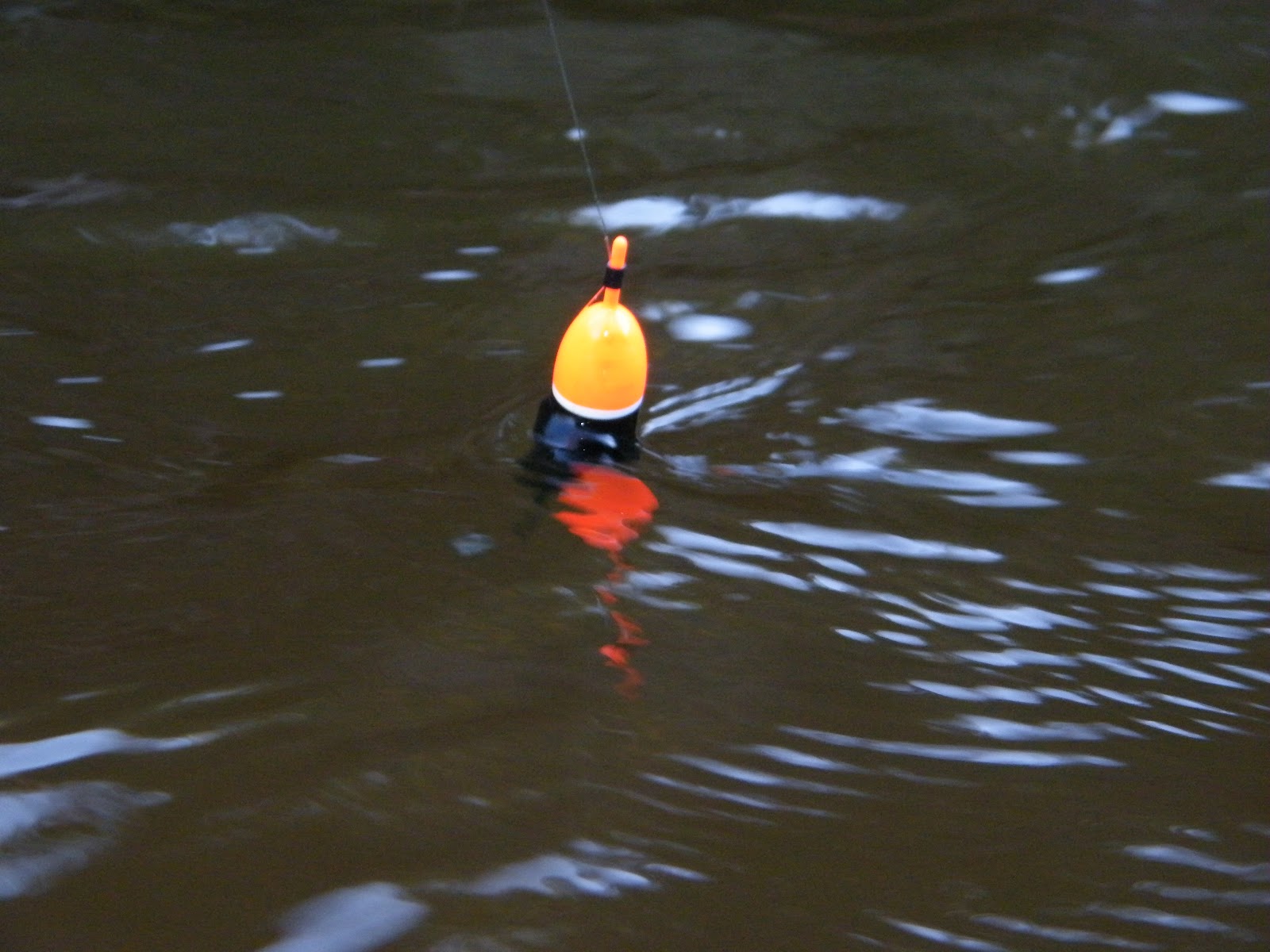
Start out shallow and slide everything up after a few drifts. This avoids drudging bottom and the possibility of spooking fish. The thing about sensitive floats is they will let you know where you are in the water column. If the float points downstream you are drudging bottom. If the float points upstream you are either set too shallow or you need more weight to match the current. What you want to see is the float straight up and down and submerged to the point that only the top is visible. This lets you know that everything is set up properly and you’re on your way to a feisty steelhead.

Hydrology tells us that the current in a river is actually faster on the surface than on the bottom. It doesn't take long for the steelhead to notice when something floating by them is awry. To slow the float down, we use a technique called "trotting" or pulling back on the float slightly during your drift. This allows you to slow the float to the same speed as the current on the bottom. 


   Presentation selection can vary. It can include such things as yarn tied to mimic a fish egg, stone and hex fly imitations, pink plastic worms, night crawlers, butter worms, wax worms and spawn. I've also had success with a local fly pattern known as a Lake Superior X-Leg. These are tied by a local company called Jeff's Jigs and are available online.


Get out and chase some of the hardest fighting, most beautiful fish that Minnesota has to offer. Please remember to handle these wild fish with care.

Garett Svir
Photography by Kim Svir

Saturday, April 14, 2012

River Mouth Fishing for Great Lakes Trout and Salmon


Snap-loc sinkers from Water Gremlin are a great choice for plunking spawn or night crawlers for Great Lakes trout and salmon. This allows you to float bait slightly off bottom. When a fish hits they don't feel any resistance because the line slides freely through the sinker.


Run your line through the sinker and through a small colored bead. Tie on a high quality barrel swivel. Tie on a leader of 16-25" of 6 pound fluorocarbon. When using crawlers inject them with a shot of air from a worm blower. If using spawn add a small marshmallow or piece of styrofoam to float eggs off bottom. Place your rod into a holder and watch for bites. Bites can range from the rod doubling over, to something as subtle as the line going slack. Cast this rig out where river current runs into the lake.


This technique can pay big dividends when fish are staging and preparing to make their spawning migration but low water and unfavorable conditions dictate that they wait.


Garett Svir
Slab Seeker Fishing


Snap-Loc Dipsey


Thursday, April 5, 2012

Cedar Plank Grilled Salmon

Ingredients:
1 lb fresh salmon
2 tbs brown sugar
1 tbs pure maple syrup
Yellow mustard
Olive oil
Four peppercorn blend to taste
Sea salt to taste


Directions:
Start out by soaking an untreated cedar plank in water for about 20 minutes. This will prevent it from catching on fire while on the grill. Preheat grill to 300 degrees. Rinse salmon in cold water before rubbing the piece of salmon with mustard, salt, pepper, brown sugar, and pure maple syrup.  Take the cedar plank out of water then rub it with olive oil to prevent sticking. Place the salmon skin side down on the cedar plank. Grill the salmon for approximately 40 minutes at 300 degrees or until it reaches an internal temperature of 135 f. Note: Keep a spray bottle of water nearby in case the cedar plank would start to burn. Remove cedar plank from the grill and serve. This truly is a delicious yet simple recipe for salmon. My favorite!

Enjoy!


Beverage Recommendation: Granite City's Brother Benedict's Bock

Sunday, March 18, 2012

Kamloops Fishing on Lake Superior

This time of year is always bitter sweet for me. It's that time of year when I realize that my winter fishing season is over. I'm going to let you in on a secret that will help you with your winter fishing withdrawals. It won't cost more than a few bucks in gas and a tub of wax worms. It's the incredible fishery that exists on the shorelines of Minnesota's Lake Superior. Early March is the time that Lake Superior Kamloops Rainbows begin to stage off river mouths in anticipation for their spring spawning migration. It's a time of year when these large Great Lakes fish are within casting distance from shore and can make for a memorable outing. The best part is a big boat or charter is not needed and this can all be done with equipment you currently own.

  Many areas from Duluth to the Canadian border can produce fish but I prefer areas that are in close proximity to warm water discharges or river mouths. These areas with warmer water are going to offer food and attract fish. Steelhead and Kamloops always return to spawn in their birth stream and spend the months of February and March seeking out these streams. This makes them susceptible to a wide variety of offerings from a savoy angler.

As for equipment I like to use long light action rods. The long rod allows for greater casting distance. It also allows you to fight large fish on light line by fighting them on the rod rather than the line. Simply keeping your rod tip up will absorb alot of the shock from the powerful runs these fish make. Just don't make the mistake of pointing your rod at the fish or all shock is taken by the line. A reel with a good ball bearing drag system will also help bring these fish to hand. For line I like an abrasion resistant 6 pd test. This keeps my line from getting nicked up on the many boulders that line Lake Superiors shoreline, but is not visible in the clear water.
   The two main techniques used are bobber fishing and plunking. A variety of weighted bobbers are available that allow you to get enough distance to get out past the shoreline rocks. A leader of 18-30" is then added. On the business end a special jig tied with rubber legs and a marabou tail known locally as a "looper bug" is the bait of choice. I've also used small bead head flies, night crawlers, wax worms and fresh spawn tied into mesh bags.

The second method is much like a walleye rig. It starts by adding a sliding sinker followed by a bead and then a high quality barrel swivel is tied onto the line. A leader of 16-25" of fluorocarbon is then tied on, followed by a #6 hook. This rig is tipped with a night crawler filled full of air from a worm blower or a mesh sack filled with spawn and a marshmallow. This rig is cast out and the slack line reeled up. The bait floats up off bottom and the line slides freely through the sinker on bottom. It is placed into a rod holder and watched closely for bites. Bites can range from violent strikes ripping line to something as simple as the line going slack. I have made a few sand spike rod holders by taping a chuck of PVC pipe onto a piece of re-rod. This can be driven into the sand and holds up to even the most violent strikes from passing Kamloops Rainbows.

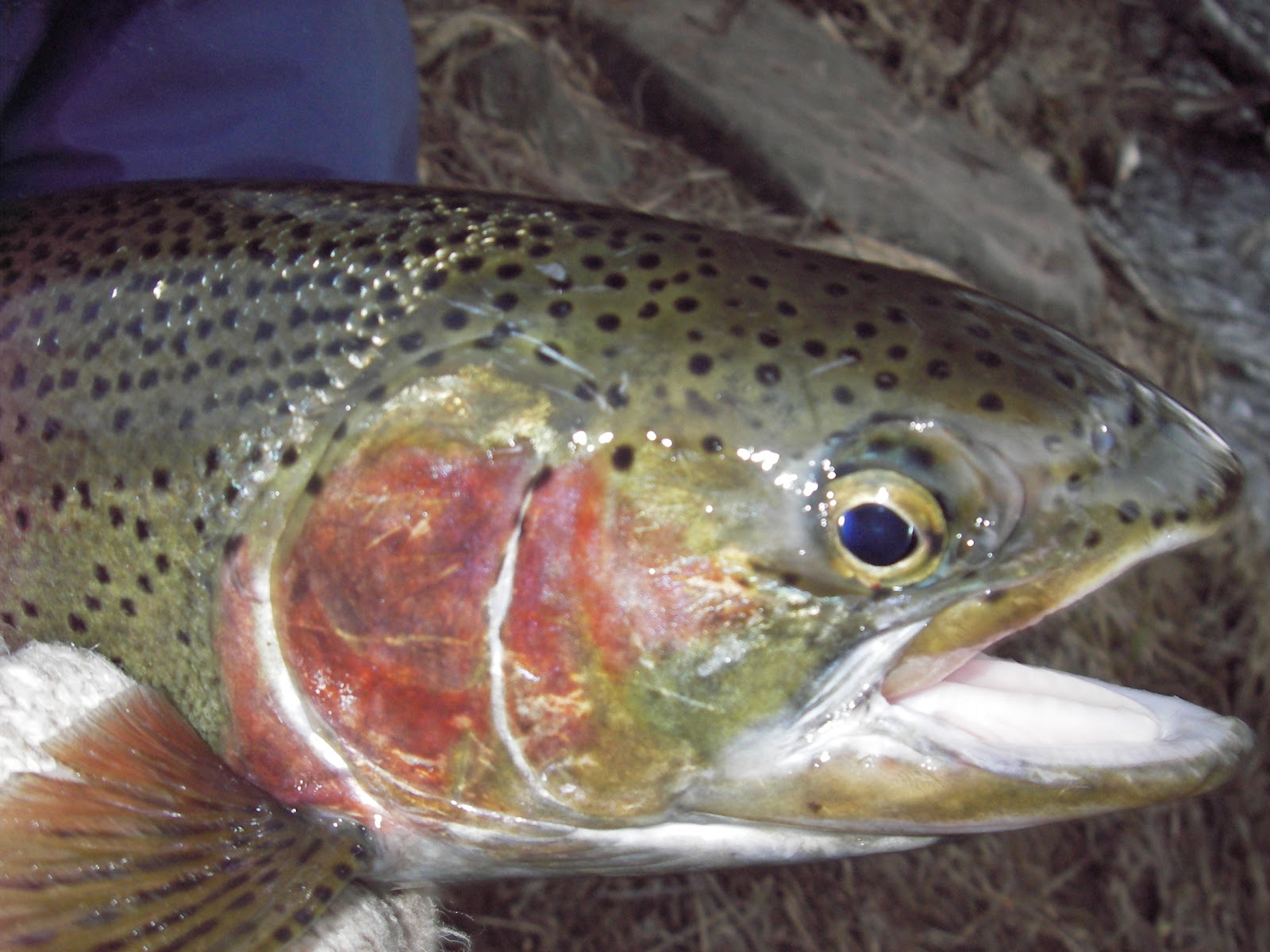
The Kamloops Rainbows of Lake Superior are stocked by the Minnesota Department of Natural Resources. These fish can be identified by a clipped adipose fin. Any fish that has an adipose fin is a wild steelhead and must be immediately released. If you do hook into a wild fish be sure to not over handle the fish. These fish should only be handled briefly for a photograph. Keep them in the water at all times. Wet hands before handling to not rub the protective slime coat off the fish. If this slime coat is damaged the fish is susceptible to infection. The steelhead of Lake Superior were in danger during the 1990's. The fish are starting to rebound due to responsible angler handling and a strict catch and release policy adopted by the Minnesota DNR. Should you catch one please do your part to protect this great fish.

Fill the void left over from the ice fishing season with a trip to Lake Superior for Kamloops Rainbow Trout. These fish make drag burning runs often leaping a few feet out of the water once hooked. You will not be disappointed. Who knows you may become "hooked" yourself!


Monday, March 12, 2012

Russian River Coho Fly

I am going to show you how to tie a Russian River Coho Fly. I've used this pattern with great success for Great Lakes King Salmon and of course on Kenai River Sockeyes in Alaska. If you plan to use this fly on the Russian River or at the Kenai and Russian River confluence area keep in mind that you cannot have a hook gap of over 3/8". The key for me is to tie them SPARSE. If you use a lot of buck tail the fly will be buoyant and not sink until the middle of your drift. Salmon are on the bottom and you want to get down to them as quickly as possible. Try the Russian River Coho Fly for your dream Alaskan vacation or simply as a pike or Chinook Salmon pattern on your local waters, you will not be disappointed.


Supplies
Hooks-
 Gamakatsu Russian River #2 streamer hooks or Mustad 36717 are popular choices.
Thread-
I like black in a 2/0 size.
Buck tail-
 As for buck tail, you'll need an orange and a white. People use many different color combinations but split orange and white most closely resembles a cloud of plankton, the favorite food source of the Sockeye Salmon. A red and white fly is thought to imitate a tiny fish called a sandlance and is the second most popular choice.
Tools-
 Hair stacker, scissors and water based head cement.
Optional Materials-
 Chenille or tinsel for body material and crystal flash for added sparkle.


Instructions
 1. Wrap your hook shank about half way down with thread. Tie in body material if you choose.
 2. Wrap thread back to eye of hook then add a small drop of head cement.
 3. Cut white buck tail and put into stacker. Pinch between thumb and index finger and hold onto one side of the hook.

 4. Wrap around shank tightly with thread. Repeat for other side with orange buck tail. I like to tie both colors in seperately to keep colors seperate.

 5. Finish by making 4-5 wraps with thread around both sections of buck tail. Be careful not to crowd the hook.

6.Whip finish and add a few drops of head cement.

Saturday, March 3, 2012

Salmon Patties

Ingredients:
-1 1/2 lbs of Fresh Alaskan Salmon
-2 Eggs
-1/2 cup of chopped onions
-1 roll of Ritz crackers
-2 tbs flour
-1cup of milk
-2 tbs butter
-four peppercorn seasoning


Directions:
Salmon Patties- Use grinder to grind fresh salmon. Mix fresh salmon in mixing bowl with 2 eggs, 1/2 cup chopped onion, and roll of crumbled Ritz crackers. Make mixture into 4 patties and place on greased pan. Season patties with four peppercorn seasoning. Bake at 350 for 1/2 hour.


Sauce- Melt butter in small saucepan. Stir in flour and four peppercorn seasoning. Add milk and cook over medium heat until bubbly. Stirring often. Cook and stir 1 to 2 minutes more until sauce thickens.


Smother patties with sauce and enjoy!


Recommended Beverage: Samuel Adams Mighty Oak Ale