
Slab Seeker Fishing - Guide Service, Freelance Writing & Product Promotion: Contact Garett Svir 320-428-5174 or garettsvir@gmail.com
Popular Posts
-
 Well the secrets are out! I've been working on some diagrams for the Water Gremlin Sinkerizer. These are the rigging methods that we com...
Showing posts with label Slab Seeker Guide Service. Show all posts
Showing posts with label Slab Seeker Guide Service. Show all posts
Thursday, June 23, 2016

Tuesday, December 3, 2013
Back Country Bluegills
I had an opportunity to chase some back country bluegills with the crew from HSM this past weekend. The morning started off slow as we worked through a large coontail flat that had produced some nice fish for me on Friday. After striking out and what seemed like a million holes later, we made our way into the 9' depression in the middle of the bay. Small perch begin to light up our Vexilar's as they raced up to steal our euro larva. Must have been a large bug hatch going on from the amount of fish located over the mud basin. Every once and awhile a larger fish would come through high in the water column and these were bluegills. While we didn't capture any true backwoods monsters on this trip, our average fish was around 9" with the largest specimens going 9.75". The hot bait of the day was the Half Ant from Clam and seemed to produce fish with whatever we happened to tip it with. All fish were released to pass on those good genetics. I hope this snow coming doesn't goof things up for us. Tight Lines!


Thursday, August 15, 2013
Making Streamside Omelets- By Brule River Fishing Guide
Making
Streamside Omelets
By:
Garett Svir
Photography:
Kim Svir

It was a cool July morning on
Alaska’s Kenai Peninsula when we made our way onto the drift boat. Pure
adrenaline and excitement had taken over as the 30” Kenai River rainbows we had
been dreaming of became a distinct possibility. Thoughts of fly selection fill
my mind as we made our way out into the fog. I had spent the night before
carefully assembling a fluorocarbon leader and tipping it with the only prince
nymph I felt worthy of these legendary Kenai River rainbows. I cannot deny the
initial disappointment that came over me as Alaska Troutfitter’s Guide Eric
Perkins handed me a 6 weight yielding something that looked like it came off a
6th graders friendship bracelet. I am by no means a fly fishing
purist but had a hard time believing that some of the largest rainbows on earth
were going to fall victim to these gaudy pieces of plastic. I think he could
sense my disappointment as I grabbed the rod from him.

As we began our decent into the
canyon, I couldn’t help but look over at the other drift boats and wonder if
they too were using such unrefined offerings. Our guide carefully navigated
around a few boulders and instructed my wife, Kim, to “hit the shot” on the far
current seam. She rolled out a large cast and as soon as she mended her
indicator dipped below the surface. I caught a glimpse of silver as the large
fish rolled beneath the surface. I guess that bead fishing was starting to grow
on me, but it took several large rainbows of my own before I completely bought
in. Throughout the day, our guide would reach into a rubber made tool box and
pull out different colors of nail polish. He would change the shade of our
beads to match the stage of salmon eggs in the river. Alaskans are serious
about bead fishing and for good reason. The original owner of Alaska
Troutfitters, Curt Trout, was one of the first anglers to experiment with
plastic beads. He would train guides by having them paint beads that would
later be taken to the river and compared to the real thing. They would drop different
beads amongst salmon eggs until the apprentice and Curt could not tell the
difference. Curt Trout has now passed on; however, the shops new owners, Dusty
and Billy, have continued on with his legacy of being well versed in bead
fishing. The secret bead painting room is only accessible by two employees.
Their trademark way of painting beads to achieve that perfect molted swirl is
known throughout Alaska. While we didn’t end up hooking a 30” rainbow, several
fish over the 20” mark started a love affair with bead fishing that would
travel back to my home streams on the Great Lakes.
In the past few seasons, I have
really gained confidence in bead fishing. Last fall, during my annual
pilgrimage to the Pierre Marquette River, I couldn’t help but try them on king
salmon. We had absolutely amazing results. On previous trips we would start our
adventure several hours before daylight, casting minnow baits in complete
darkness. Once the sun came up we would fish through holes using cut skein. By
afternoon the bright skies would eventually cause the bite to die off. This
year we found bead fishing could extend this notorious morning bite late into
the day by simply downsizing from skein to beads. We were amazed to find how
light these kings would bite during the afternoon, often times just causing our
floats to pause or drift sideways for a moment. Even with bright bluebird skies
they could not pass up a single egg drifted past them.

On Lake Superior’s Bois Brule River
local fly patters like the glimmer soft hackle, spring wiggler and Lake
Superior x-leg are considered the norm for steelhead. We found many willing
steelhead using… you guessed it, beads. Actually they worked so well on this
gin clear, spring fed, trout stream that they have become my confidence bait here
on my home water. Fall is a great time to use smaller beads in caramel roe or
apricot to mimic the many brown trout eggs washing downstream. Spring runoff
will muddy up the water and colors like chartreuse and tangerine really shine.
Runoff that contains a lot of red clay is common on Lake Superior streams.
Chartreuse and yellow beads will often look far more natural than any shade of
orange or red in these conditions.
Opaque colors of nail polish can give eggs the mottled look like they
have been in the river awhile. Small drops of pink, orange and even black nail
polish can further refine offerings, imitating a nucleus. I was a skeptic at
first but have since found that the possibilities are endless for imitating the
common egg. I now sometimes find myself on all fours inspecting eggs lying on
the bank or boat floor trying to match the hatch.

When trying to match the egg
hatch, I try to keep in mind the size of eggs fish are feeding on. If fish are
feeding on eggs from steelhead, sockeye, suckers or whitefish, I tend to start
with a 6mm. If fish are feeding on eggs from pinks or silvers, I start with an
8 mm. The largest I personally carry is a 10 mm and I use these when fish are
feeding on larger eggs from king or chum salmon. The other important factor is
color. Matching bead color to the color of eggs that fish are feeding on seems
like an easy task; however, several factors come into play. Keep in mind the
time of day and available light penetration, color of the water, amount of
sediment and if runoff is stained from tannic acid swamps or red clay banks.
All of these factors can make the bead look different underwater. The easiest
test is to inspect beads underwater before drifting. This allows you to make
adjustments and also check visibility. As a final test, I hold beads up to the
sun to look at how the light passes through them. I have found that translucent
beads catch more fish. The secret lies in making the bead translucent but not
so shiny that they spook finicky fish. The last but certainly not least
important factor to consider is the stage of the eggs the fish are keying in
on. Eggs change color constantly as they develop into the alevin stage. The
nucleus that is originally present changes over to two distinct black dots as
the embryo is formed. The embryo will then begin to form a darker red yoke sack
along the bottom portion. In the later stages, eggs look white as the embryo
can be seen through the egg. When an egg dies and is washed downstream, it
quickly takes on a yellowish hue. If it is plagued by fungus or algae, it will
become green. Rather than getting too caught up in the details carry a large
selection and change beads often until you find something that works.

One of
the great things about beads is how customizable they are. While Alaska
Troutfitters’ Shop Manager, Laura, wouldn’t tell me any trade secrets she
highly recommended a three step process. Painting with opaque nail polish will
give beads the mottled look like they have been in the water. Another trick is
to spray white or yellow paint into a paper bag, let the paint dry slightly,
add beads and shake. This will achieve the same effect but is far less time
consuming. Leave beads on a newspaper to dry and you are ready to fish. I have
also been known to hand paint a nucleus, black dots to represent embryo eyes or
a small red yoke sack spot on the bottom of beads. My final step is always to
dip painted beads in Soft-Tex. This will give beads a softer more realistic
feel and protect nail polish from chipping.

Rigging beads is not a difficult
venture. Common practice is to peg beads a small distance above the hook. This
will assure that fish are not hooked deeply. It also serves to hide the hook in
clear conditions and prevents large beads from covering the hook gap. Beads can
be pegged using a toothpick, small clear commercially available pegs, or tied
onto the line using a bead knot. I have seen angler’s
fish beads under floats, with strike indicators and along the bottom, all with
great success. Make them work with the style of fishing you are accustomed to.

Bead fishing is here to stay and a
valuable tool to add to your steelhead fishing arsenal. Experiment by painting
different colors and changing throughout the day. You’ll be whipping up
streamside omelets in no time.
Sunday, March 24, 2013
North Shore of Lake Superior Spring Photo Essay
Well it's almost steelhead season on Lake Superior's North Shore. Great time to look back on some of last years adventures..


Monday, March 18, 2013


Wednesday, September 12, 2012
Lake Superior Pink Salmon
Pink Salmon
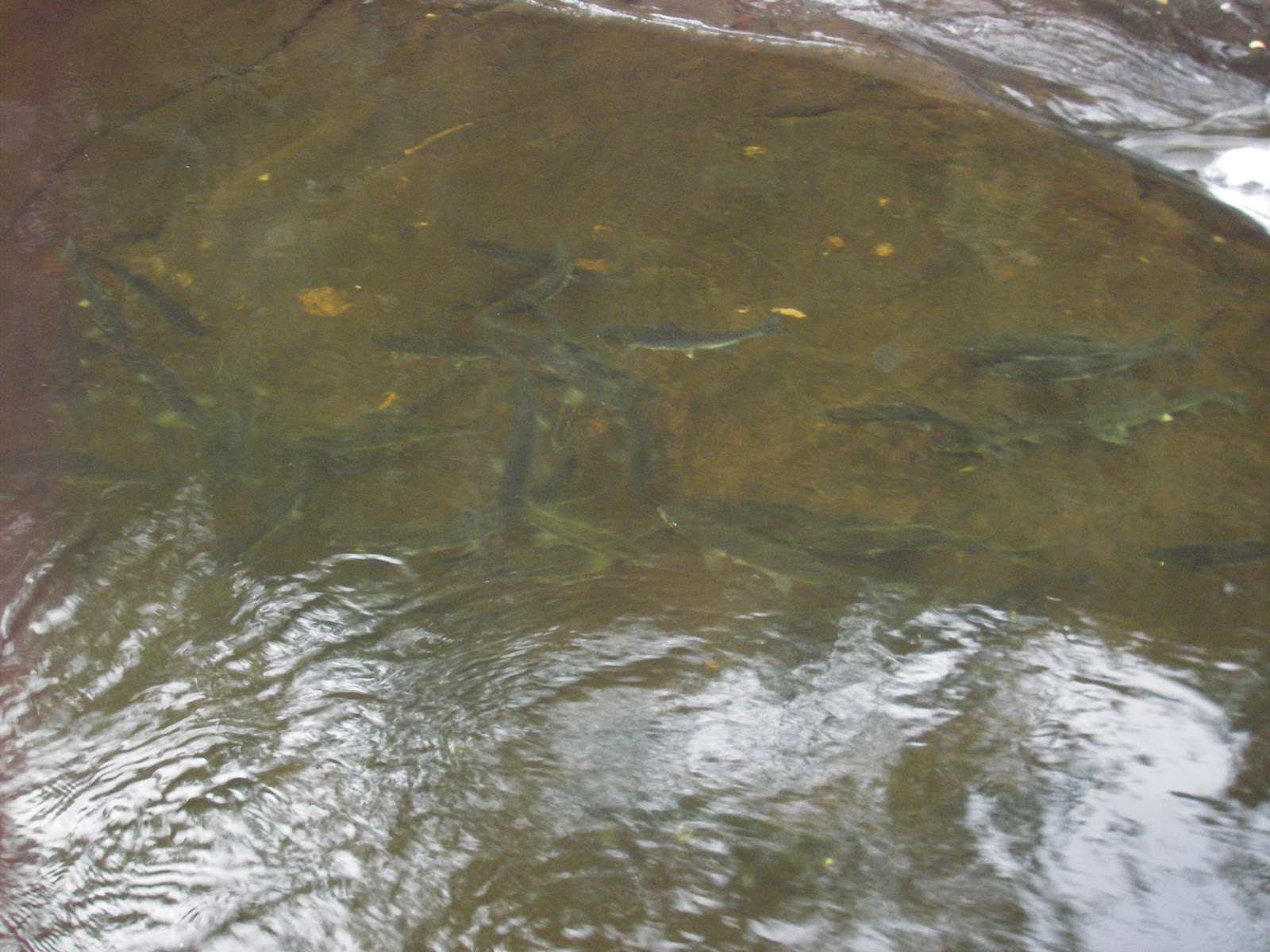
Today I’m going to let you in on a little secret. You can
find Alaska quality fishing right
out your front door on the North Shore of Lake Superior. When I think of 50
fish days on the fly rod, my mind drifts to the Kenai
River Alaska ,
but you don’t have to go that far. September is prime time for the only self
sustaining population of salmon on the North Shore, the pink “hump back”
salmon. A very under utilized fishery exists and these runs are of Alaskan
proportions! The fish are small averaging 10-18” but can raise havoc on a 5 wt
fly rod. The state record is 4.5 lbs. Pods of 100 fish can be found and provide
some very fast action.
My battle
axe of choice is a 5 weight fly rod spooled with weight forward line. I prefer
to use a strike indicator to not line fish in these big pods. I then employ 2
BB split shot to get down to the strike zone. On the business end of things, I
like #8 rainbow x-legs, #8 brown wooly buggers and #8 cerise glow bugs. These
fish are not feeding conversely their stomachs are actually disintegrating to
make room for eggs and milt. You want flies that trigger that territorial
strike. I see a lot of people using hardware but experience has taught me one
of these flies “dead drifted” thru a pod of fish will elicit more strikes.

As for
stream selection, many North Shore

The time is now! So get out and catch
some of Lake Superior ’s hidden gem… the pink salmon. Use
light action gear and have some fun. A 50 fish day may be in your future. See
ya on the water.
Garett Svir
Subscribe to:
Posts (Atom)