Popular Posts

Wednesday, October 31, 2012

Happy Halloween

Happy Halloween 
From:
 Slab Seeker Fishing


Wednesday, October 3, 2012

The Dark Side of Winter Steelheading


What some consider a trend in fishing like trucker hats, those masks that block UV rays and small video cameras that people strap to their head while fishing, I consider the single most effective piece of fishing equipment I own for winter steelhead. I’m talking about the centerpin reel. A centerpin reel is a large fly type reel with a ball bearing or bushing drive system. The reel spins freely on a single center pin and feeds out line at the precise speed of the current. This is a very important trait when fishing finicky winter steelhead. Steelhead are very accustomed to food drifting past them and even with a brain the size of a pea can tell when something is awry. Getting your bait to move at the speed of the current can be accomplished with fly and spinning gear at a short distance. Only a centerpin can allow you to keep your bait in the strike zone for the entire length of the run. This allows people fishing floats to drift their floats many yards downstream simply by the pressure of the water. An angler is only limited to the amount of water they can cover by their eye sight and courtesy for anglers downstream.

The history of the center pin reel is said to date back to the Chinese over a thousand years ago when large round reels were used simply as line holding devices. Large smooth wooden reels that could spin freely were later refined in the UK and known as Nottingham Reels. They were used to fish salmon on the famous Trent River. They were further refined and made into the modern day centerpin by the bicycle maker Henry Coxon in 1896. Because his reel was made of metal it would spin much easier and wobble less than its wood predecessors. While centerpins have remained popular for recreational and match fishing anglers alike in the UK, they did not catch on until recently in the United States. Paul Almanza from Anglers International, one of the largest centerpinning companies, tells me that centerpins became popular on the Great Lakes in the late 1990’s. In the past few seasons I have seen more anglers than ever fishing with centerpins on Great Lakes Tributaries. I guess the secret is finally out.
One of the main advantages of a centerpin is that it lengthens drifts and minimizes your down time. It also allows you to fish water that would otherwise be inaccessible like undercut banks, back eddies and areas that can only be reached by casting straight downstream. The main advantage however is that you can apply slight pressure to the spool as it is feeding out line to slow down your float. When float fishing we need our floats to move slightly slower than the surface current. Hydrology tells us that the current in a river is actually faster on the surface than on the bottom. To slow the float down, we use a technique called trotting or putting slight pressure on the spool with your pinky or ring finger as line feeds out downstream. This allows you to slow the float to the same speed as the current on the bottom. Centerpinners also place split shot on their line in specific patterns that allow them to slice through the heavy surface current and get down to where the fish are.

 Centerpins present a unique challenge to anglers because most models possess no drag system. Instead the reel is palmed on the bottom of the spool and light pressure is applied when fighting fish. To be honest your first few fish may not make it to the net. The excitement of fighting your first winter steelhead without a drag system is sure to have you coming back for more.
Centerpins are often coupled with long light action rods to protect line and aide in casting. According to Paul, from Anglers International, the most difficult task is learning to cast a centerpin. Several different casts exist and include the side cast, spinning side cast, Wallis cast and single and double loop casts. I would recommend that new “pinners” take the time to learn the Wallis Cast. While it may be the most difficult cast to learn, it does not create line twists and will save you a lot of frustration in the long run. Detailed instructions on all of these casts are available on the Anglers International website at http://www.anglersinternational.com.  

I am glad that a practice referred to as “going over to the dark side” by fly fishing enthusiasts is making its way into the hands of anglers on the Great Lakes. If you haven’t made the trip over yet, I encourage you to. The dark side is loaded with chrome fish!

Wednesday, September 12, 2012

Lake Superior Pink Salmon


Pink Salmon 
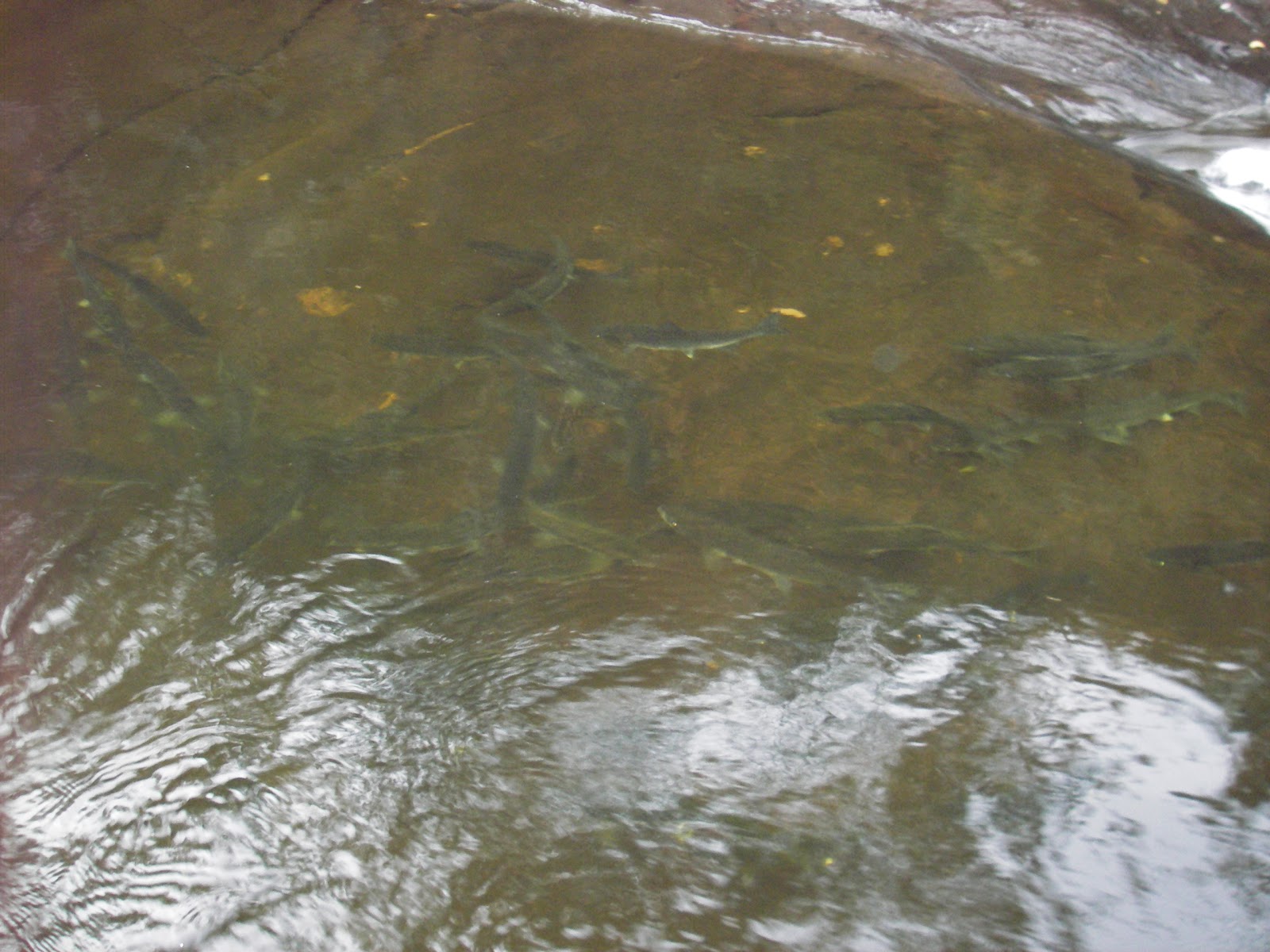
Today I’m going to let you in on a little secret. You can find Alaska quality fishing right out your front door on the North Shore of Lake Superior. When I think of 50 fish days on the fly rod, my mind drifts to the Kenai River in Alaska, but you don’t have to go that far. September is prime time for the only self sustaining population of salmon on the North Shore, the pink “hump back” salmon. A very under utilized fishery exists and these runs are of Alaskan proportions! The fish are small averaging 10-18” but can raise havoc on a 5 wt fly rod. The state record is 4.5 lbs. Pods of 100 fish can be found and provide some very fast action.


   My battle axe of choice is a 5 weight fly rod spooled with weight forward line. I prefer to use a strike indicator to not line fish in these big pods. I then employ 2 BB split shot to get down to the strike zone. On the business end of things, I like #8 rainbow x-legs, #8 brown wooly buggers and #8 cerise glow bugs. These fish are not feeding conversely their stomachs are actually disintegrating to make room for eggs and milt. You want flies that trigger that territorial strike. I see a lot of people using hardware but experience has taught me one of these flies “dead drifted” thru a pod of fish will elicit more strikes.
          

  As for stream selection, many North Shore streams receive huge runs of these fish. Water conditions are low right now so invest in a good pair of polarized glasses and go looking for some fish. These fish are decaying rapidly so concentrate your efforts on the first few pools up from the lake and intercept them coming in.


            The time is now! So get out and catch some of Lake Superior’s hidden gem… the pink salmon. Use light action gear and have some fun. A 50 fish day may be in your future. See ya on the water.
Garett Svir  

Monday, August 20, 2012

Get Nocturnal for Big Cats


It may come as a surprise to a lot of my trout fishing buddies but one of my favorite species to pursue is the channel catfish. It’s not a fish I chase for table fare or for its photogenic appearance. I pursue channel cats because they really put up a fight! They also allow me the opportunity to get nocturnal and get away from the crowds to relax. There is something therapeutic about launching my boat under the moonlight and heading to one of my favorite holes on the river for a little cat fishing.
            Channel cats are most active at night. They have a few traits that make them such efficient night time hunters. First, they are armed with a very high amount of olfactory receptors in their nostrils that give them an incredible sense of smell. They are also equipped with four pair of whiskers that are covered with taste buds. They are actually omnivores and will take a variety of baits. Savvy anglers however choose baits that appeal to their two strongest senses, their sense of smell and their external taste buds.
            I’ve experimented with a variety of different bait choices that included commercially processed stink bait pellets, dead suckers, night crawlers and dip baits. My confidence bait however for late summer cats is the lowly chicken liver. A tub of chicken livers from your grocer’s meat department will last an evening of fishing. It will also create a scent slick in the water that will call cats in from long distances. We’ve set up one rod with night crawlers and the other with chicken livers and caught 5 fish to 1 on the chicken livers, on several different occasions. The hard part can be getting them to stay on the hook. We listen carefully after casts and if a second splash is heard we reel in and re-bait. 
            When fishing at night I like to keep my rigs as simple as possible to avoid tangles. It’s funny how we can go months without seeing a tangled line when fishing during the day but as soon as we step foot in the boat after sunset we inevitably have a rod tangled. A simple bottom fishing rig consisting of a large egg sinker and 18” of leader is all that is needed. Spool up with a fluorescent 20 pound test monofilament. Catfish have very hard mouths so I choose to ante up for the premium hooks that are chemically sharpened. I’ve taken my nieces and nephews out and had success on circle hooks but for me not being able to set the hook takes away from the experience. I prefer a 3/0 octopus style hook. Before putting the rod into the holders I attach a glow stick to my rod tip for visibility. I like the Cliplight from Starlite because it attaches directly to the rod tip without tape or awkward attachments that come off during casts. Many anglers will attach bells to their rod tips to signal strikes but I personally tend to lose them when casting.
            At night channel cats are on the move feeding but you still want to position yourself in a high percentage area. My favorite spots are at the heads of holes. I try and set up where I can fish close to the drop off where the swifter water stops. Other traditional spots to look for include wing dams, fallen trees and other major current breaks. Channel cats will hunker down in deeper holes during the day and come up shallow to feed at night. Two rod holders off the back of the boat will allow you to anchor off the bow and keep lines tight to signal strikes. Shore fishing is also a great option in many areas. Anglers use sand spike rod holders to hold rods in place as they refresh baits and tend to the fire.
             While a ten pound fish is very respectable, bigger specimens are possible. Trophy caliber channel cats of 20 plus pounds are landed every year. The biggest specimen ever caught was 58 pounds taken from the Santee Cooper Reservoir in South Carolina.
            Contrary to popular belief the whiskers of a catfish are completely harmless and will not sting you. When handling cats the part you want to avoid is the sharp spines on the pectoral and dorsal fins. I usually grab catfish by the tail and place my other hand under the belly to support the fish.
            Get out and chase channel cats whenever you get the opportunity. I used to fish cats with a guy that claimed his biggest fish always came when the barometer was falling. I would get late night phone calls claiming that the big cats were going to be “on” and to grab my gear. Some nights they were and others not, so the jury is still out on this theory. Make a stop at the grocery store for some chicken livers and get nocturnal for big cats!
By: Garett Svir
Photography: Kim Svir

Saturday, August 11, 2012

How To Drift For Kenai River Sockeye Salmon

Drifting for sockeye salmon can be frustrating at first. The sockeye salmon is known as the shy salmon for a reason, they are shy biters. Proper rigging techniques are the first thing to focus on. To start out you will need 
  1. Large snap swivels
  2. Several packages of 1/2 ounce and 3/4 ounce Water Gremlin Snap-Loc Dipsey Sinkers
  3. Several Russian River Coho Flies
  4. A spool of 30 pound test monofilament
  5. 8 weight fly line
Attach your fly line to the 30 pound test mono using a nail knot. Cut off monofilament at around 3 feet. Tie end to swivel with snap end first. Attach snap swivel to 1/2 or 3/4 ounce Water Gremlin Snap-Loc Dipsey Sinker. Tie remaining end of swivel to 30 pound monofilament. Cut section 4 1/2 to 5 1/2 feet long. Attach Russian River coho fly.
Start out by pulling out some fly line. The biggest mistake people make is trying to fish too much line. You don't want to have to strip much in, so start out short. Sockeye salmon are going to follow the shoreline and you don't want to fish out past migrating fish. Cast straight out in front of you to the 12 o'clock position. Lead with your rod tip to about the 2 o'clock position. Make a big sweeping downstream hook set. Re- cast out to the 12 o'clock position and repeat. 

If you feel your line stop at any time throughout your drift, sweep your rod tip downstream to set the hook. If you become stuck simply pull straight back and the Snap-Loc Sinker's pin will pull out of the sinker freeing your line. Simply snap on a new sinker and begin drifting again. Make sure you are making good bottom contact throughout your drift. If you are only ticking occasionally move up to the 3/4 ounce size. If you are becoming stuck alot opt to downsize and go with the 1/2 ounce size. Pound for pound sockeye salmon are one of the hardest fighting fish on the planet, get out and give them a shot. Alaska's Kenai River has seen runs of record proportions the past couple seasons. 
The Slab Seeker

Monday, July 30, 2012

Alaska- A Photo Essay

They say that a picture is worth a thousand words... In the case of Alaska I'd say 10,000 words, so without further ado, we bring you Alaska! 
Kim Svir


All images are property of Slab Seeker Fishing. 
If you are interested in stock images of fishing related content, please contact me at slabseekerfishing@hotmail.com 
Kim