Popular Posts

Saturday, December 22, 2012

Bluegills Secrets Reveled


Bluegills Secrets Reveled
By: Garett Svir
Photography: Kim Svir
It’s 5 am and you’re up brewing coffee. Lake map in hand you make last minute decisions before heading out to load gear. Mother Nature’s icy grip has taken hold as you head out to temperatures well below freezing. Armed with an assortment of jigs and plastics you make your way out into the frozen tundra. Big bluegills can do crazy things to a person. They can consume your thoughts. If this sounds like a normal weekend to you, then you just may have what it takes to ice a bluegill over 10” this winter. Big bluegills can be tough customers. The best eye sight in the business coupled with an uncanny way of tasting a bait before committing can make them very difficult at times. When it comes to winter bluegills it seems like 10 % of anglers are hooking 90% of the fish. So what are their secrets? I decided to pick the brains of two of the best in the business… Dave Genz and Dave Young.

Dave Genz is considered the founding father of modern ice fishing. The winter fishing system that he developed has forever changed the way that anglers ice fish. Instead of dragging a small house out onto the ice to stay comfortable, we can now stay out of the elements and remain mobile with the advent of his Fish Trap. His inventions were born out of necessity on his quest to catch more and bigger bluegills.
Genz fishes more by feel than by line watching. It is something that he refers to as cadence. “It’s just like fishing with a crank bait, you want the fish to feel it in their lateral line” says Genz.  He has learned to feel his jig pounding in the water. When he can no longer feel the jig pounding he sets the hook knowing that a fish has inhaled his offering. He prefers clear line in 2 pound test over the high visibility stuff. Genz expressed that sometimes a person has to cut the bluegills a little slack. He informed me that when the bite gets tough and you find yourself missing fish to briefly drop the rod tip and immediately set the hook. This is something that he learned by years of bobber fishing. “Sometimes you have to let them take it” explains Genz. When he started using Vexilar 25 years ago he used to write articles about how to catch sniffers, those picky fish that would not bite. He wrote about finesse presentations and dropper rigs. He has now changed his school of thought regarding this and opts to drill more holes and search out active bitters. “I want to make that first drop down a new hole” he explains. He firmly believes that those first drops down a new hole produce his biggest bluegills of the season. “At the end of the day that strategy will produce more fish” says Genz. You want to have the mindset that a small percentage of the fish in a particular body of water are bitters, and that it’s the anglers job to search out those bitters. When asked about structure he expressed that his favorite spots for bluegills are deep weed edges. He prefers to search these areas over deep basins because he can usually find less pressured fish. “Deep basin areas can be good early before the crowd develops” he explains. Once the crowds hit an area, it is beneficial to strike off to find less pressured fish.

You may remember Dave Young from the television reality series Ice Men that aired on the Versus Channel. Young is considered an authority on tight line fishing for finicky bluegills. Spending 35 years on the hard water, Young has also seen it all. He knows how to get it done in tough conditions. Young has spent countless hours showing others the art of tight lining. When he is teaching someone to tight line, he does not let his students use a flasher. He believes that this can be a distraction for anglers new to this style of fishing. “An angler must first learn to watch their line and detect subtle strikes” he explains. This also forces new anglers to fish the entire water column and they will often catch fish that come in quickly from outside the cone angle of the flasher. The amount of concentration that Young employs is unmatched. He jokes of bringing Advil with him on tournament day because he gets headaches from concentrating too much on his line. If you watch Young with a jigging rod it almost looks like he is jigging in a circle. When questioned Young stated, “A jigging style is like a finger print and is unique to every angler.” You can still believe that I am going to add circle jigging to my bag of tricks this winter. “I am watching my line as far down into the water as I can see it” tells Young. This allows him to see even the slightest irregularities in his jigging sequence. He’s watching the small kinks in his line that appear while jigging. If he notices the kinks in his line straighten out, he sets the hook. He is also looking for his line to go slack. This alerts him that a fish has grabbed his bait and swam up in the water column. His line of choice is 2 pound test Stren in high visibility yellow. He likes the way yellow shows up against snow and ice. He developed an ice rod for HT and pairs it with a small plastic reel called a Schoolie. On tournament day, 28 rigged rods will make it onto the ice. This allows Young to switch presentations quickly without taking the time to re-tie. Throughout the interview he stressed the importance of versatility. “Some times I work fish from the top down and other times I work them from the bottom up” he explained.

The play book is open. The best in the business have revealed tactics to help you ice more bluegills this winter. I hope that some of those bluegills make it back down the hole. I recently learned of an organization called Recycled Fish. They are encouraging anglers to release their largest bluegills to keep big fish genetics in our favorite lakes and ensure big fish in the future.  Become more than a sportsman, become a steward of our lakes and take the sportsman’s stewardship pledge at http://www.recycledfish.org.


Tuesday, November 13, 2012

Spoon Tactics for First Ice


If you're anything like me, you have probably been at the public access checking the ice every night after work. I keep a chisel in the back of my truck and stop on the way home. My rods are rigged and tackle boxes organized. First ice always leaves me feeling like a kid on Christmas morning. While I primarily spend my hard water season chasing panfish, first ice has me dreaming of walleyes. It can be a short window of opportunity but during the first few weeks of the hard water season the planets align.  The walleyes bulk up for the long winter ahead. Oxygen rich waters and large baitfish call for aggressive tactics. My favorite of which is the jigging spoon. Jigging spoons drop down fast in deep water allowing you to put the miles on necessary to ice some walleyes.


A handful of jigging spoons is all that is needed to get started. Different spoons can be used to impart different actions. Some are meant to be fished with bigger jigging motions, while others respond to the slightest movements. I learned a lot about how to fish different spoons by watching them on my underwater camera. The general rule of thumb is to jig more with thicker spoons and less with thinner ones.  I would recommend something with a rattle like the Northland Buckshot Rattle Spoon or Lindy Rattl’n Flyer for a search lure. These lures make a lot of commotion and call fish in for a closer look. While you may have to switch to a less aggressive spoon to get a commitment, these spoons will give you an idea if fish are present in the area. A second choice would be a thin flutter spoon like the JB Weasel. These impart a much different action than their bulky counterparts and are needed to seal the deal some days.  My third choice, and an absolute classic, would be Bay De Noc’s Swedish Pimple. I caught my first winter walleyes using these spoons and never leave them behind to this day. Lastly, I wouldn't be without the Northland Macho Minnow. The small flicker tail can keep a walleyes attention with a simple squeeze of the rod handle. While you could add many other effective choices to your arsenal, this will give you plenty of different actions to tempt even the most discerning of marble eyes. 


My favorite part about spoon fishing early ice walleyes is that they allow you to fish fast. Even in deep water you can quickly drop a spoon down, jig a few times, reel up and move. This allows me to sort through several pieces of structure along with previous hot spots in a single outing. I no longer spend long periods of time camped out in last years “hot spot” waiting for the sun to set. I have been burned by that strategy before. Spoons allow me to work through an area. If no fish are present I keep searching. If I am seeing a lot of fish on my electronics but not getting any to bite, I make a way point on my hand held GPS and return once the sun slides behind the trees.


Standard jigging for me consists of dropping my spoon to the bottom. I then reel up 1-2 ft off bottom and hold for five seconds. I then raise my spoon about a foot with a sharp motion and return to my original position, letting the spoon fall on a slack line. I then pause again and repeat. When a fish is seen on my electronics I switch to much smaller jigging motions.

I make a point to fish every hole that I drill even if no fish are present on the flasher. Walleyes don't school up as tight as panfish. Many times I will walk up and stick my transducer into a hole to discover nothing. After dropping my spoon to the bottom a fish will appear. I don't recommend committing large amounts of time to holes that are void of fish. Drop the spoon to the bottom, reel up a foot, hold for five seconds, jig, hold, and move on. Before leaving the hole I usually swing the transducer in the hole like a pendulum in order to see what’s happening outside of the beam or cone. If I notice a suspended line, I will give the hole a little more time.


When a fish comes into view 1 of 3 things will usually happen. #1. The fish will rise up to the spoon and crush it. This is everyone's favorite scenario and happens more during early ice than any other time. Walleyes have typically had several weeks without pressure. Combine that with nature telling them to bulk up for the long winter ahead and you have a receipt for success. #2. Is what we like to refer to as a stand off situation. The walleye will rise up, or come in suspended, and sit right below your spoon. Just like a police swat team, I try to avoid a standoff at all costs. The best avoidance technique is to keep working fish up and up and up. I refuse to let walleyes get too good of a look at my presentation in fear they may realize it is an imposter. One technique that can produce is to squeeze the rod handle and lift at the same time. It imparts just enough action to get the treble hook to swing back and forth in a very tantalizing manner that marble eyes can't resist. Another technique that can work is to place you index finger on the rod blank and lightly tap while lifting at the same time. We refer to this technique as the smoker, as it mimics someone ashing a cigarette. While smoking is terrible for your health, the only effect you will feel from this method is violent strikes from passing fish. My standard technique is small 1- 2" jigging motions while either lifting slowly or holding right above the fish. #3. The third scenario is when a fish comes in for a look and drops back down to the bottom. In this scenario, I always feel like I have nothing to lose. One big jigging motion followed by a pause will often cause the walleye to turn around for one last look.  I have not had great success with dropping the spoon down to the fleeing walleye. When a fish turns around for one more look I will usually lift the spoon an additional foot. A quick lift sets off the predatory response and forces them to make a decision before their meal escapes. 


The wait is finally over! It’s time to get out and catch that first walleye meal of the season. Experiment with some different jigging motions. The tips here are only guidelines to get you started. Each fish needs to be “read” and coaxed individually through the use of your electronics. If the fish don’t seem to like what you are doing, change it up until you find something that works for you. Working on my dabble is what keeps me coming back and keeps me dreaming of first ice.

Wednesday, October 3, 2012

The Dark Side of Winter Steelheading


What some consider a trend in fishing like trucker hats, those masks that block UV rays and small video cameras that people strap to their head while fishing, I consider the single most effective piece of fishing equipment I own for winter steelhead. I’m talking about the centerpin reel. A centerpin reel is a large fly type reel with a ball bearing or bushing drive system. The reel spins freely on a single center pin and feeds out line at the precise speed of the current. This is a very important trait when fishing finicky winter steelhead. Steelhead are very accustomed to food drifting past them and even with a brain the size of a pea can tell when something is awry. Getting your bait to move at the speed of the current can be accomplished with fly and spinning gear at a short distance. Only a centerpin can allow you to keep your bait in the strike zone for the entire length of the run. This allows people fishing floats to drift their floats many yards downstream simply by the pressure of the water. An angler is only limited to the amount of water they can cover by their eye sight and courtesy for anglers downstream.

The history of the center pin reel is said to date back to the Chinese over a thousand years ago when large round reels were used simply as line holding devices. Large smooth wooden reels that could spin freely were later refined in the UK and known as Nottingham Reels. They were used to fish salmon on the famous Trent River. They were further refined and made into the modern day centerpin by the bicycle maker Henry Coxon in 1896. Because his reel was made of metal it would spin much easier and wobble less than its wood predecessors. While centerpins have remained popular for recreational and match fishing anglers alike in the UK, they did not catch on until recently in the United States. Paul Almanza from Anglers International, one of the largest centerpinning companies, tells me that centerpins became popular on the Great Lakes in the late 1990’s. In the past few seasons I have seen more anglers than ever fishing with centerpins on Great Lakes Tributaries. I guess the secret is finally out.
One of the main advantages of a centerpin is that it lengthens drifts and minimizes your down time. It also allows you to fish water that would otherwise be inaccessible like undercut banks, back eddies and areas that can only be reached by casting straight downstream. The main advantage however is that you can apply slight pressure to the spool as it is feeding out line to slow down your float. When float fishing we need our floats to move slightly slower than the surface current. Hydrology tells us that the current in a river is actually faster on the surface than on the bottom. To slow the float down, we use a technique called trotting or putting slight pressure on the spool with your pinky or ring finger as line feeds out downstream. This allows you to slow the float to the same speed as the current on the bottom. Centerpinners also place split shot on their line in specific patterns that allow them to slice through the heavy surface current and get down to where the fish are.

 Centerpins present a unique challenge to anglers because most models possess no drag system. Instead the reel is palmed on the bottom of the spool and light pressure is applied when fighting fish. To be honest your first few fish may not make it to the net. The excitement of fighting your first winter steelhead without a drag system is sure to have you coming back for more.
Centerpins are often coupled with long light action rods to protect line and aide in casting. According to Paul, from Anglers International, the most difficult task is learning to cast a centerpin. Several different casts exist and include the side cast, spinning side cast, Wallis cast and single and double loop casts. I would recommend that new “pinners” take the time to learn the Wallis Cast. While it may be the most difficult cast to learn, it does not create line twists and will save you a lot of frustration in the long run. Detailed instructions on all of these casts are available on the Anglers International website at http://www.anglersinternational.com.  

I am glad that a practice referred to as “going over to the dark side” by fly fishing enthusiasts is making its way into the hands of anglers on the Great Lakes. If you haven’t made the trip over yet, I encourage you to. The dark side is loaded with chrome fish!

Wednesday, September 12, 2012

Lake Superior Pink Salmon


Pink Salmon 
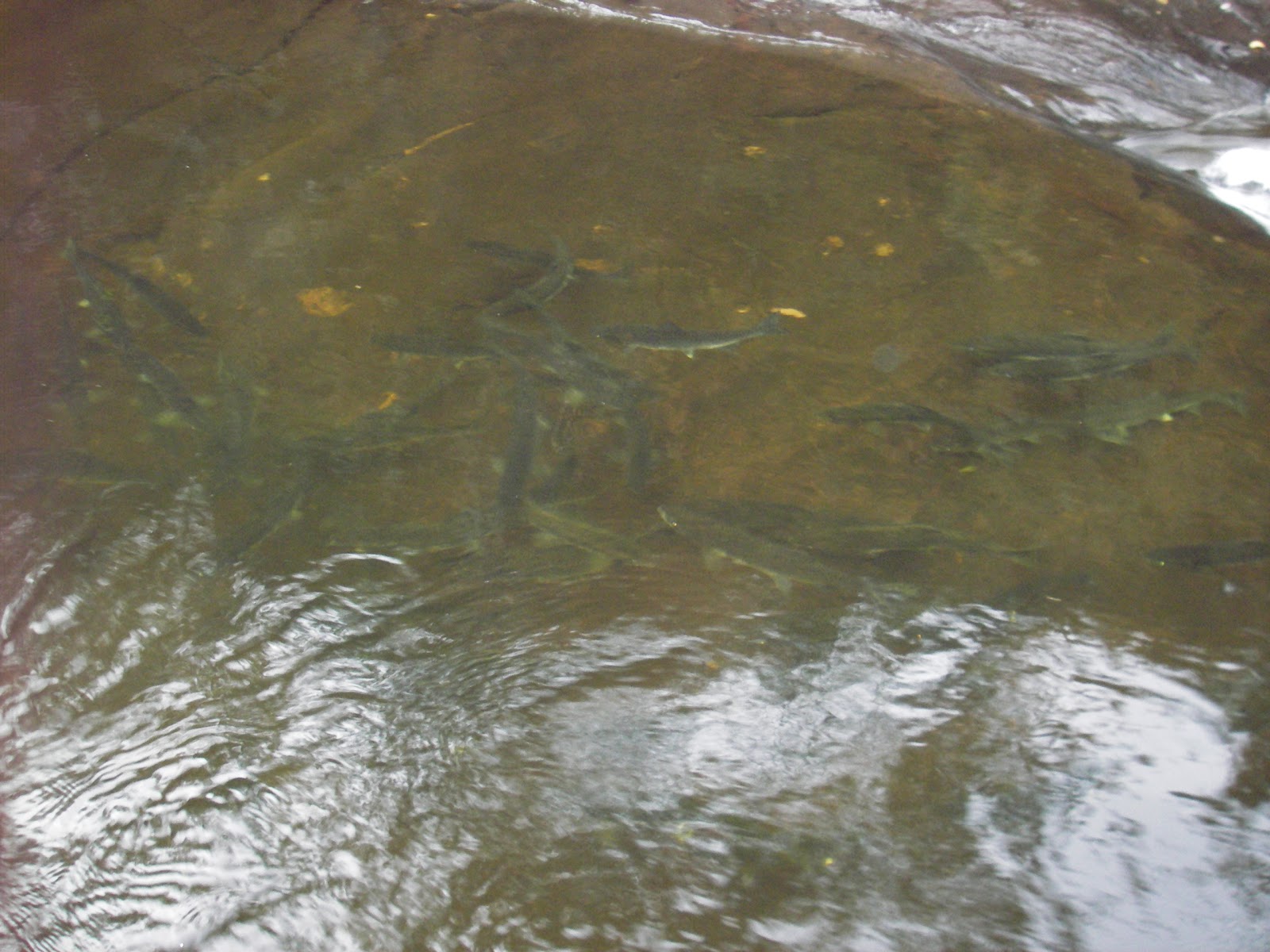
Today I’m going to let you in on a little secret. You can find Alaska quality fishing right out your front door on the North Shore of Lake Superior. When I think of 50 fish days on the fly rod, my mind drifts to the Kenai River in Alaska, but you don’t have to go that far. September is prime time for the only self sustaining population of salmon on the North Shore, the pink “hump back” salmon. A very under utilized fishery exists and these runs are of Alaskan proportions! The fish are small averaging 10-18” but can raise havoc on a 5 wt fly rod. The state record is 4.5 lbs. Pods of 100 fish can be found and provide some very fast action.


   My battle axe of choice is a 5 weight fly rod spooled with weight forward line. I prefer to use a strike indicator to not line fish in these big pods. I then employ 2 BB split shot to get down to the strike zone. On the business end of things, I like #8 rainbow x-legs, #8 brown wooly buggers and #8 cerise glow bugs. These fish are not feeding conversely their stomachs are actually disintegrating to make room for eggs and milt. You want flies that trigger that territorial strike. I see a lot of people using hardware but experience has taught me one of these flies “dead drifted” thru a pod of fish will elicit more strikes.
          

  As for stream selection, many North Shore streams receive huge runs of these fish. Water conditions are low right now so invest in a good pair of polarized glasses and go looking for some fish. These fish are decaying rapidly so concentrate your efforts on the first few pools up from the lake and intercept them coming in.


            The time is now! So get out and catch some of Lake Superior’s hidden gem… the pink salmon. Use light action gear and have some fun. A 50 fish day may be in your future. See ya on the water.
Garett Svir  

Monday, August 20, 2012

Get Nocturnal for Big Cats


It may come as a surprise to a lot of my trout fishing buddies but one of my favorite species to pursue is the channel catfish. It’s not a fish I chase for table fare or for its photogenic appearance. I pursue channel cats because they really put up a fight! They also allow me the opportunity to get nocturnal and get away from the crowds to relax. There is something therapeutic about launching my boat under the moonlight and heading to one of my favorite holes on the river for a little cat fishing.
            Channel cats are most active at night. They have a few traits that make them such efficient night time hunters. First, they are armed with a very high amount of olfactory receptors in their nostrils that give them an incredible sense of smell. They are also equipped with four pair of whiskers that are covered with taste buds. They are actually omnivores and will take a variety of baits. Savvy anglers however choose baits that appeal to their two strongest senses, their sense of smell and their external taste buds.
            I’ve experimented with a variety of different bait choices that included commercially processed stink bait pellets, dead suckers, night crawlers and dip baits. My confidence bait however for late summer cats is the lowly chicken liver. A tub of chicken livers from your grocer’s meat department will last an evening of fishing. It will also create a scent slick in the water that will call cats in from long distances. We’ve set up one rod with night crawlers and the other with chicken livers and caught 5 fish to 1 on the chicken livers, on several different occasions. The hard part can be getting them to stay on the hook. We listen carefully after casts and if a second splash is heard we reel in and re-bait. 
            When fishing at night I like to keep my rigs as simple as possible to avoid tangles. It’s funny how we can go months without seeing a tangled line when fishing during the day but as soon as we step foot in the boat after sunset we inevitably have a rod tangled. A simple bottom fishing rig consisting of a large egg sinker and 18” of leader is all that is needed. Spool up with a fluorescent 20 pound test monofilament. Catfish have very hard mouths so I choose to ante up for the premium hooks that are chemically sharpened. I’ve taken my nieces and nephews out and had success on circle hooks but for me not being able to set the hook takes away from the experience. I prefer a 3/0 octopus style hook. Before putting the rod into the holders I attach a glow stick to my rod tip for visibility. I like the Cliplight from Starlite because it attaches directly to the rod tip without tape or awkward attachments that come off during casts. Many anglers will attach bells to their rod tips to signal strikes but I personally tend to lose them when casting.
            At night channel cats are on the move feeding but you still want to position yourself in a high percentage area. My favorite spots are at the heads of holes. I try and set up where I can fish close to the drop off where the swifter water stops. Other traditional spots to look for include wing dams, fallen trees and other major current breaks. Channel cats will hunker down in deeper holes during the day and come up shallow to feed at night. Two rod holders off the back of the boat will allow you to anchor off the bow and keep lines tight to signal strikes. Shore fishing is also a great option in many areas. Anglers use sand spike rod holders to hold rods in place as they refresh baits and tend to the fire.
             While a ten pound fish is very respectable, bigger specimens are possible. Trophy caliber channel cats of 20 plus pounds are landed every year. The biggest specimen ever caught was 58 pounds taken from the Santee Cooper Reservoir in South Carolina.
            Contrary to popular belief the whiskers of a catfish are completely harmless and will not sting you. When handling cats the part you want to avoid is the sharp spines on the pectoral and dorsal fins. I usually grab catfish by the tail and place my other hand under the belly to support the fish.
            Get out and chase channel cats whenever you get the opportunity. I used to fish cats with a guy that claimed his biggest fish always came when the barometer was falling. I would get late night phone calls claiming that the big cats were going to be “on” and to grab my gear. Some nights they were and others not, so the jury is still out on this theory. Make a stop at the grocery store for some chicken livers and get nocturnal for big cats!
By: Garett Svir
Photography: Kim Svir